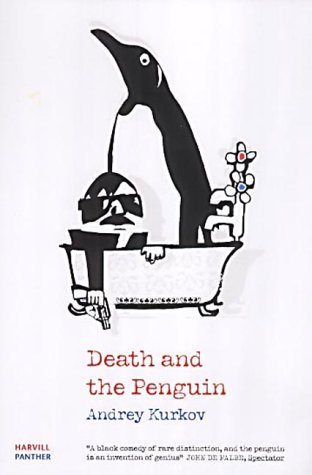
Kurkov’s understated humour and perfect, deadpan style makes this quirky little story, full of quirky characters, a gem. Death and the Penguin is the nectar of booklovers and Misha, a penguin rescued from a struggling zoo, is one of the most animated, engaging and touching characters in contemporary fiction. But there’s more to Kurkov’s writing than a sideways laugh at human foibles. Death of Penguin shows many pictures of loneliness and human isolation. Viktor is an aspiring writer but lacks the energy to follow his dreams and, by settling to bread today and giving up on the idea of jam tomorrow, finds himself drawn into a mafiaesque world of crime and assassination in the chill starkness of post-Soviet Kiev. Misha comes to live with him when the local zoo can no longer afford to feed him. Both are lonely, Viktor isolated from human society and Misha alone amid it. Yet it is Misha who seems able to make strong relationship – first with Sonia, a little girl who comes to live with Viktor when her father is swept away into oblivion by his life of crime and then with the reader: who cannot fail to adore the quite, reliable, predictable animal, or to delight in his pleasure in fish and cold bathes, or sorrow over his inability to adjust to life in a climate so much warmer than his native land.
Here too is a stark, if one-sided, portrayal, of life in the former Soviet state of Ukraine. And it’s not a nice life. It’s cold, it’s hard and seemingly pointless. Deprived of the structure of the state, each seems to struggle to embrace with vigour the concept of democratic freedom. What Death of the Penguin amounts to is a strong indictment of a political reform which has left a population, bereft of communism community, without any societal fabric at all: without hope, without security and unable to realise the promise of liberty. This book is very funny. It’s very sad. And it’s very, very good.
Read and reviewed in December 2006
©Jessica Mulley 2006
- 2025
- 2021
- 2020
- 2019
- 2018
- 2016
- 2015
- 2014
Blog posts of '2014' 'August'
Kurkov’s understated humour and perfect, deadpan style makes this quirky little story, full of quirky characters, a gem. Death and the Penguin is the nectar of booklovers and Misha, a penguin rescued from a struggling zoo, is one of the most animated, engaging and touching characters in contemporary fiction. But there’s more to Kurkov’s writing than a sideways laugh at human foibles. Death of Penguin shows many pictures of loneliness and human isolation. Viktor is an aspiring writer but lacks the energy to follow his dreams and, by settling to bread today and giving up on the idea of jam tomorrow, finds himself drawn into a mafiaesque world of crime and assassination in the chill starkness of post-Soviet Kiev. Misha comes to live with him when the local zoo can no longer afford to feed him. Both are lonely, Viktor isolated from human society and Misha alone amid it. Yet it is Misha who seems able to make strong relationship – first with Sonia, a little girl who comes to live with Viktor when her father is swept away into oblivion by his life of crime and then with the reader: who cannot fail to adore the quite, reliable, predictable animal, or to delight in his pleasure in fish and cold bathes, or sorrow over his inability to adjust to life in a climate so much warmer than his native land.
Here too is a stark, if one-sided, portrayal, of life in the former Soviet state of Ukraine. And it’s not a nice life. It’s cold, it’s hard and seemingly pointless. Deprived of the structure of the state, each seems to struggle to embrace with vigour the concept of democratic freedom. What Death of the Penguin amounts to is a strong indictment of a political reform which has left a population, bereft of communism community, without any societal fabric at all: without hope, without security and unable to realise the promise of liberty. This book is very funny. It’s very sad. And it’s very, very good.
Read and reviewed in December 2006
©Jessica Mulley 2006
I can't deny that I really enjoyed reading this - I raced right through it in a few hours. At the same time, however, I think it is a little disappointing. I love the concept - the Minotaur of Knosses, still alive and now living within society somewhere deep in the American South. The possibilities promised by such a premise are endless: unfortunately, Sherrill simply fails to deliver. Here is no exploration of immortality or historicity, no hilarious misunderstandings, very little plot and absolutely no use of the dynamic between fantasy and reality which itself should have been able to sustain the novel.
The Minotaur is an engaging character, and the picture of his loneliness and isolation elegant and touching. His friends and work colleagues are well-drawn and interesting characters - no one could fail to be repelled by Shane and his sidekick Mike,
or the way in which they exploit the Minotaur's insecurity - but it's not enough to raise this engaging and easy to read novel above the average.
Read and reviewed in December 2005
© Jessica Mulley 2006
A horrible and true tale of football, witchcraft, murder and the King of England
In recounting the events surrounding the alleged bewitchment of a young girl, living in a quiet, rural village in Berkshire in 1604, Sharpe provides a fascinating depiction of medieval life from an unusual perspective. The Bewitching of Anne Gunter is, in some ways, a very personal account of a small incident in the vastness of history. Sharpe however succeeds in demonstrating its connections with contemporary life and its consequences in the spheres of high politics, theology and cultural development that an incident which many have glossed over as an aside becomes a pivotal in both typifying and determining the early years of the 17th century.
Sharpe has a great story to tell as well. A young, seemingly attractive, girl, who suffers at the hands of her murderous and oppressive father, eventually finds release and, it is suggested love. Along the way, the reader finds football and murder, malefic witchcraft, satanic connections and an audience with the King at his glamorous Court in London. So far, it sounds a little bit like popular fiction. But this is, in fact, just what a history book should be: well-researched, well-written, enlightening and material.
Sharpe touches on so many aspects of medieval culture and society that it is difficult to encompass them all briefly. Those which stood out for me were his treatment of the distinctiveness of the phenomena of widespread belief English witchcraft in contrast to contemporary experiences in Europe and North America. He discusses in some details the psyche of medieval society, placing witchcraft firmly in a cultural context which, for the uneducated and half-educated at least include a belief in fairies and phantoms, demons and devils, and sympathetic and image magic sitting quite comfortably alongside a devote if irrational adherence to Christianity. The discussion of the emergence of printed material as an influence upon popular culture dates the phenomena to an earlier period than many histories, but Sharpe provides good evidence to support his case and convincing evidence of the impact of printed material in the case at hand. His treatment of the widespread perception that accusation of witchcraft was predominantly a manifestation of misogyny amounts to a debunking of conventional interpretations, making the book all the more refreshing and challenging. Perhaps of most interest to me however is the argument running through the books that the witchcraft phenomena of the middle ages was as much a response to religion as it was step away from it. Sharpe links closely the rise in belief in witches in England, and especially the emergence of a seeming connection between bewitchment and satanic possession, to the Reformation and its impact on the contemporary psyche.
So much was knowledge of witchcraft and possession inculcated in the folklore of the times, Sharpe argue, that those moved to feign bewitchment knew how they were expected to act and those that witnessed such bewitchment knew how to respond. Sharpe, of course, rejects outright any suggestion that witches actually existed. Yet Anne’s particular case provokes a reassessment of that conviction. There can be little doubt that she was a victim and suffered horribly. Her violent and painful fits, the swelling in her stomach which drove her to suicidal thoughts, her passing and vomiting of pins and other objects, amounts to an horrific account of cruelty and abuse. Her sufferings were not brought about by the three women she accuses of bewitching her but, according to Sharpe, by her father who was seeking to further a bitter village feud by having his enemies convicted of witchcraft. If a parent were guilty of inflicting such pain and suffering on their offspring they would be guilty of child abuse of the most horrific and unforgivable kind: is there a case for arguing that Anne father, Brian Gunter, was, after all, the ‘witch’ who plagued her?
Read and reviewed in 2006
© Jessica Mulley 2006
For me, cookbooks have to do three things: first and foremost, the recipes have to work, enabling me to produce tasty and presentable food at the first attempt. A good cook book should also be practical to use to in kitchen; and I want it to be beautiful inside and out too, gracing my bookshelves as well as inspiring me to cook. This collection of 100 low-carb recipes from Tori Haschka goes a long way towards doing all three.
The book is intended to help reduce intake of white carbohydrates. It begins with a useful but brief introduction to cooking with to low-GI pulses and beans which are used in many of recipes, but before long you reach page after page of the most gorgeously-tempting recipes. This is not fine-dining stuff, it’s solid, practical everyday home meals with a particular twist of unusual ingredients and some exotic flavouring. For the most part, the recipes call for ingredients, and techniques, which most experienced home cooks will be familiar with but there are a few recipes and techniques which will stretch some homecooks little beyond their comfort zone and some of the ingredients may need to be searched for: I don’t think I’ve ever seen rice malt syrup!
I tried the recipe for Seabass Swaddled in Courgette Ribbons with Parsley and Tarragon Salsa Verdi and was delighted to find that the instructions were straightforward and easy to understand. The fish was simpler to ‘swaddle’ than I had feared and that the results were stunning. Beautiful tasting and textured fish, doing justice to the expense of seabass, perfectly complimented by the flavours of the salsa verdi: the tarragon shone through over the parsley making the meal at once refreshingly light but at the same time full-bodied in flavour. The whole mean even scored with my husband who usually refuses to eat courgettes. He did however find it a little unsatisfying, probably because of the absence of carbs, and tucked into fruit cake immediately afterwards.
There are recipes for breakfast, snacks, salads, main meals and desserts. The breakfast recipes look tempting, but several appear far too much effort to prepare on a working day although they may work as a special weekend treat. Few of the desserts on offer tempt me – I just don’t see the point of trying to make desserts ‘healthy’, either eat them and enjoy, or don’t eat them – but I shall certainly be cooking a couple of more of the main meals such as Piri Piri Chicken with Black Beans and Tomatoes, and Thai Green Papaya Salad with Trout.
I particularly liked the brief introductions and tips which appear alongside most recipes, giving a little background to flavours, ingredients and menus and guidance on how to get the best results and potential variations.
The book, close to A4 in size, is neatly presented in wipe-clean, sturdy hard covers and printed on glossy paper which gives a least some protection against accidental spills and sticky fingers. It’s packed with full-page, colour illustrations of the recipes although I was a little disappointed to find that not every recipe was illustrated. The volume doesn’t sit open at a particular page easily, making the use of a bookstand or weight desirable if cooking straight from the recipe.
For a book that is aimed at helping you to achieve a healthy diet, it’s surprising that it doesn’t include any indication of nutritional or calorific values.
Read and Reviewed in August 2014 © Jessica Mulley 2014